

The Bangko Sentral ng Pilipinas (BSP) conducted a briefing on the amendments to its Manual of Regulations on Foreign Exchange (FX) Transactions last 06 August 2019 at the BSP Assembly Hall in Manila.
Deputy Director Jodeth Niña Yeung discussed in details the recent amendments to BSP’s Manual of FX Regulations. Highlighting that these new policy reforms made the country’s FX regulatory framework further liberalized. In fact, according to Chinn-Ito Financial Index (2016), the Philippines’ FX flow openness index remains higher compared to ASEAN neighbors: Malaysia, Indonesia, Thailand and Vietnam. Because of BSP’s facilitative and more liberalized regulations, FX transactions are now more streamlined and simplified.
The amended FX regulations include the following major reforms:
- Lifting of prior BSP approval requirement for purely private sector FX loans. Henceforth, companies need only to register.
- Replacement of a positive list to a general policy requirement for loan purposes that can be funded with proceeds of foreign currency loans. FX transactions need only be legitimate, not contrary to laws, regulations, public order, public safety, or public policy.
- Lifting of BSP registration for certain short-term private sector loans, provided these are duly reported to BSP.
- Lifting of the USD 60,000.00 Daily limit on FX sale by depository banks for the balance of peso deposit accounts of non-residents.
- Migration to electronic submission of supporting documents, from previous hard copy requirement.
- Broadened coverage of inward investment transactions from previous two (2) categories: foreign direct investments and portfolio investments, to three (3) new categories, namely: instruments issued by residents, non-residents, and other forms of investments.
- Expansion of the list of banks allowed to register investments on behalf of BSP.
- Provision of a grace period of one (1) year from effectivity of the implementing Circular to file applications for registration of investments, regardless of the date of funding.
BSP underscores that these reforms are significant leaps that will allow foreign investors, public and private entities, and overseas Filipinos to have more flexibility in managing their foreign currency transactions and investments.
However, BSP despite its continuing efforts to further liberalize FX regulations, the banks may still adopt internal policies and are expected to exercise due diligence in compliance with these amendments. –EPV
 The 9th National Education Forum (NEF) was held last 29 August 2019 at Hotel Jen, Pasay City. Attended by distinguished speakers and panelists from the government, academe, and industry, the forum discussed the impact of the Fourth Industrial Revolution (4IR) in business, work and our daily lives as well as offer solutions and insights on how to go about meeting the challenges imposed by this technological transformation.
 The speakers and panelists alike discussed the pros and cons of the 4IR. Ms. Riza Mantaring of the Management Association of the Philippines (MAP) discussed the wonders of the hologram technology- an image that appears to be three dimensional and can be seen with a naked eye. As an advanced technology, holograms can also perform operations and surgeries outside operating rooms in any country.
 ont of them. Relations will lose value as most of us now have become busy on our social media life and there is now the prevalence of fake news, voice and facial reorganization, etc, which are regarded as ethical concerns. Further, there are risks of machines overpowering humans as portrayed in movies such as Terminator and I Robot.”
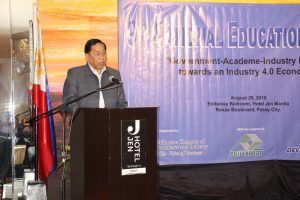 PHILEXPORT President, Mr. Ortiz-Luis, emphasized the importance of “government officials, educational institutions, business leaders, and policymakers in pushing forward advocacies on education such as 4.0 workforce readiness, strengthening government-academe-industry linkages as well as best practices on multi-skilling workforce and plotting the ways forward in future-proofing work in the Philippines.”
 Commerce and Industry (PCCI), the Export Development Council (EDC), PHILEXPORT and the Employers Confederation of the Philippines (ECOP) are all working on policies towards identifying the breadth of jobs that are likely to be threatened by this technological advancement. Noting for example is the rapid progress in Artificial Intelligence (AI), which indicates a much broader range of jobs than previously thought could be carried out by machines. Therefore, the Commission on Higher Education and other government agencies shall make sure that essential policies shall bring up symmetrical balance so that we will not be worried about automation affecting employment in the country.”
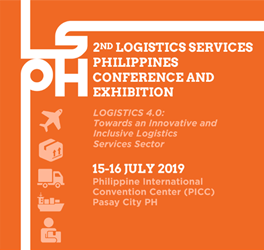 The President of Multimodal and Logistics Association Inc. (PMTLAI) Ms. Marilyn C. Alberto, reported during the 2nd Logistics Services Philippines Conference and Exhibition (LSPH) that the issuance of the Joint Administrative Order (JAO) which focuses to address the problems on high shipping cost and port congestion will be the “long term solutions to the problems that affects the logistics services ability to enable business competitiveness.”
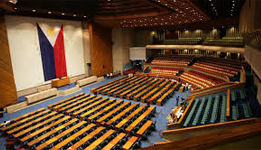 The Export Development Council (EDC) through its Networking Committee on Legislative Advocacy and Monitoring (NCLAM) has prioritized the export sector’s legislative agenda for the 18thCongress to have a more competitive export industry.
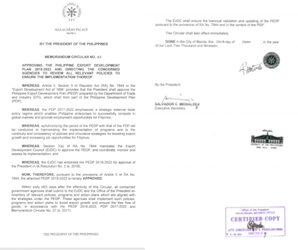 In a Presidential Memorandum Circular (MC) No. 62 approving the Philippine Export Development Plan (PEDP) 2018-2022, concerned government agencies are mandated to implement their respective programs, activities and projects (PAPs) relevant to the PEDP.
 In a recent pronouncement, DTI Secretary Ramon Lopez stated that the Departments of Trade and Industry, Transportation and Finance will issue the Joint Administrative Order (JAO) that will regulate local charges imposed by international shipping lines.
 The Department of Tourism recognizes the importance of developing domestic airports in improving competitiveness and enhancing sustainable growth both in tourism and trade. It is also highlighted that the airports are not just gateways but more of economic growth drivers. This objective is included in the National Tourism Development Plan (NTDP).
 During the 4th Annual Philippine Airport Modernization and Expansion Summit, DOT Undersecretary Arturo Boncato, Jr. shared that the tourism sector generated more than 5 million employment and 12.2% contribution to GDP in 2017. Initial data shows that there are about $ 8 billion income generated from tourist arrivals in 2018.
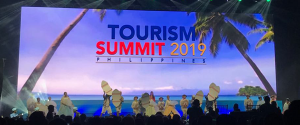 The Department of Tourism (DOT) in collaboration with Go Negosyo and other partners like the ASEAN Business Advisory Council, Department of Foreign Affairs, Tourism Board of the Philippines, Philippine Chamber of Commerce and Industry and the Filipino Chinese Chamber of Commerce and Industry , conducted the country’s First National Tourism Summit last 02 May 2019 held at the World Trade Center in Pasay City.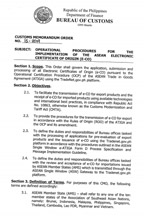
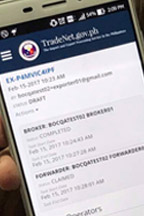 the TradeNet system and attach all documentary requirements by uploading it to the system. If approved, the exporters will receive an email containing a downloadable and printable file for the e-CO. Otherwise, the Exporter/s will be informed of the reason for disapproval through email and may file another application for e-CO.Since the full electronic sharing of e-CO among AMS is not yet operational and while the AMS are addressing all technical failures, “the Exporter shall download then print the e-ATIGA Form D, place his or her signature in the appropriate space, and submit the system-generated ATIGA Form D to the Bureau (BOC) for manual execution of signature and seal”.